
Beyond the AI Hype: Jui Tan on Data, Deployment, and Real-World Value

The hotter the market gets, the more important it is to ask where real value is being created.
Lanchi Ventures has long invested across foundation models, AI applications, and Physical AI, backing companies including Moonshot AI (Kimi), Genspark, Galbot, and AGIBOT. These investments reflect a conviction built over time: lasting companies do more than ride a technology wave. They identify real needs, build in real-world settings, accumulate valuable data, and keep improving.
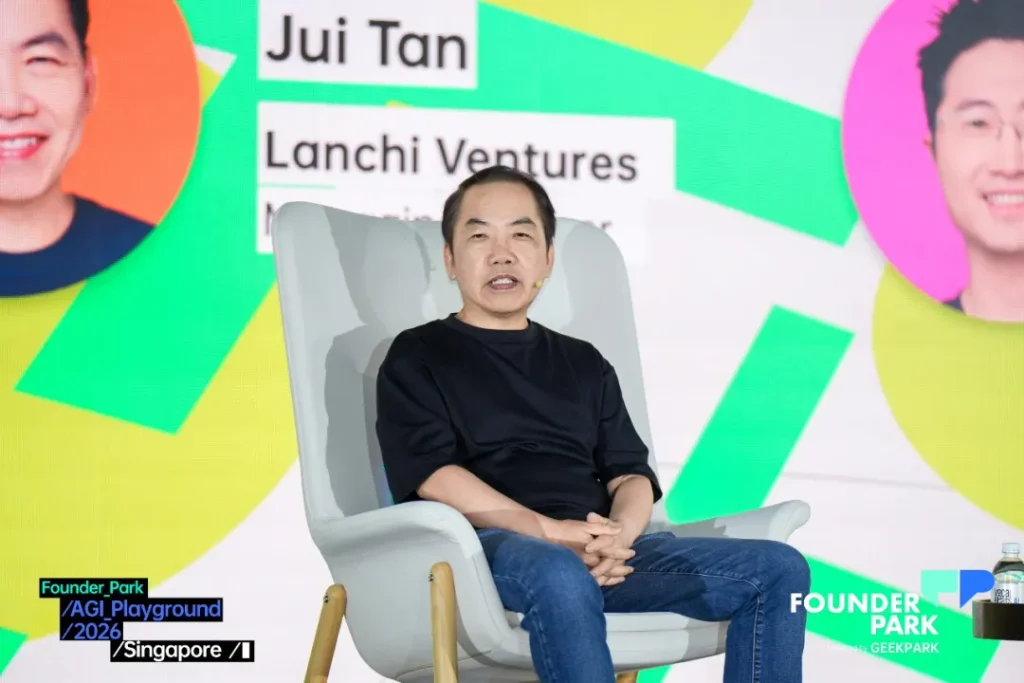
On August 3, Jui Tan, Managing Partner of Lanchi Ventures, joined Peter Chen, Founding Partner of Alphaist Partners, for a conversation at AGI Playground 2026 in Singapore, an event initiated by GeekPark’s Founder Park. Drawing on Lanchi’s experience as an early-stage investor, Jui discussed the changing AI market, how investors value different types of AI companies, and what it will take for Physical AI to move from technical progress to practical deployment.
His central message was clear: as foundation models grow more capable, startups need a deeper understanding of specific users and settings, along with data that others cannot easily replicate. For Physical AI, the real test is whether robots can do useful work. And for companies choosing between closed and open-weight models, cost, data protection, and deployment needs are becoming increasingly important.
The conversation below has been edited for clarity.
1. The Hotter the Market, the More Important Real Differentiation Becomes
Peter Chen: What changes in the AI industry have stood out to you over the past 12 months?
Jui Tan: I see three notable shifts, especially for Chinese founders, whether they are based in China or abroad.
First, the market has heated up. Valuations have risen sharply, even for companies at a very early stage.
Second, more talented engineers are starting companies. Some come from major AI labs, while others have worked at startups. This is happening as capital returns to the sector—not only in venture capital, but also in public markets. There is still volatility, yet significantly more money is flowing into AI.
Third, attention is converging around a smaller set of opportunities. That makes these areas easier for investors to study, but it also means more founders and more capital are pursuing similar ideas. Competition will intensify, and some mistakes are inevitable.
Peter: With the market changing so quickly, what kind of company still makes you want to move fast?
Jui: Two or three years ago, the investment map was easier to read. Large language models, semiconductors, GPUs, and emerging applications were the obvious areas to explore. Today, with more capital and more competition, differentiation matters much more.
Physical AI offers a good example. Despite all the investment in the sector, robots still lack enough high-quality data about physical interaction. We have been looking for companies that can help close that gap. Earlier this year, Lanchi invested in OriginFlow.
OriginFlow looks beyond first-person video data and uses advances in algorithms to make electromyography, or EMG, signals valuable for robot training. When someone picks up a bottle, small muscle contractions generate electrical signals. Capturing those signals can give robots another source of data about how people move and help them learn more precise, human-like actions. It addresses a missing piece in the development of Physical AI.
We take a similar view of AI agents. We are cautious about backing a standalone agent feature that a foundation-model company could soon offer itself. Instead, we look for startups with proprietary data, a distinctive use case, and a deep understanding of the context in which people use their products.
There is often a meaningful gap between what a state-of-the-art model can do and what a user actually needs. Most users are not developers. They do not want to work out how to make a model useful; they want a product that understands their task and helps them complete it. Closing that gap is where an application company can create lasting value.
2. Will Models Replace Applications? The Moat Lies in Use Cases, Data, and Feedback Loops
Peter: As foundation models improve and move further into applications, is there still room to build an AI application company?
Jui: There is, but founders need to be very clear about whom they serve and what makes their product valuable. The market is still evolving, so I would frame this as an observation rather than a final answer.
Enterprise customers and consumers have very different needs. Many businesses initially gave their teams budgets to try a range of AI tools and model subscriptions. They quickly found that extensive use could become expensive. As AI adoption grows, cost becomes a practical concern.
Businesses are also increasingly focused on protecting their data and intellectual property. They may worry about how information is handled by a closed model provider. Application startups face another risk: a model provider can enter their category. Cursor, for example, built on Anthropic’s models; after Anthropic launched Claude Code, the two companies also became competitors.
Consumers face a different calculation. They usually pay for AI products themselves, so ease of use and affordability matter enormously.
A founder needs to decide which of these customers to serve. A companion AI product, for instance, needs to understand an individual’s preferences, emotions, and context well enough to feel genuinely useful. An enterprise product may need to protect sensitive data while delivering results at a sustainable cost. Those are different problems, and they require different strengths.
The question is not simply whether you can build a smarter model. It is whether you can create value in a particular setting that a general-purpose model cannot easily deliver on its own.
We have seen fewer AI application startups and more Physical AI companies seeking funding over the past six months. Part of the reason is that application founders now have to think much harder about competition from model providers and the advantages they can build for themselves.
Capital has recently favored foundation models and Physical AI. That does not settle the long-term outlook for applications. If application companies develop real advantages and show sustained revenue growth, investors may view the sector differently in six months or a year.

3. AI Company Valuations Ultimately Come Back to the Value They Create
Peter: How do you think about valuing AI companies, particularly agents?
Jui: At the early stage, valuation is still largely shaped by supply and demand. Strong founding teams attract interest, and more investors are competing to back AI companies. For an application or agent startup that does not need to pretrain its own model, the team and the level of investor interest often carry considerable weight.
Physical AI and foundation-model companies have a different cost structure. Pretraining requires substantial computing capacity, so some teams may need to raise $50 million to $100 million in a Series A round. Their valuation is influenced not only by investor demand, but also by how much capital they need and how much ownership they can afford to give up. We have seen Series A pre-money valuations reach $200 million to $300 million.
An application company and a company training models or building Physical AI may both be called “AI startups,” but their capital needs—and the logic behind their valuations—are quite different.
4. China’s Manufacturing Sector Is a Training Ground for Physical AI
Peter: Investment in AI hardware and Physical AI has risen sharply. What is driving that interest?
Jui: There are both policy and industry factors.
In China, embodied AI has become an area of focus as the country enters its 15th Five-Year Plan period. That has contributed to a strong investment consensus.
There is also a difference between the Chinese and US software markets. China has not yet developed an enterprise AI market with the same willingness to pay for software as the US. Many investors, including us, invested in Chinese SaaS companies, but relatively few delivered the returns people expected. As a result, Chinese AI founders often see more immediate opportunities in consumer products or Physical AI.
China’s manufacturing base is another major advantage. Robots need real tasks, real operating environments, and feedback from physical interaction to improve. China’s factories and supply chains offer many such settings. They provide opportunities to deploy robots, learn from their performance, and collect data that cannot simply be downloaded from the internet.
Those factors help explain the current enthusiasm. Still, a strong long-term case for Physical AI should not be confused with the market’s short-term heat. Early-stage investment cycles can turn quickly.
Peter: Physical AI companies are taking very different approaches. What tells you a team is making meaningful progress?
Jui: Estimates for when Physical AI will mature vary widely. Some believe the shortage of real-world data puts broadly capable robots a decade or more away. More optimistic founders expect substantial deployment within five years. It is too early to know which timeline is right, but we can see that the technology is improving.
We have invested in robotics companies including Galbot, AGIBOT, and TARS Robotics. Their data suggests that a scaling effect is beginning to emerge: as robots are trained on more data, their capabilities improve. Five years ago, teaching a robot a relatively simple task could require a great deal of time and effort. AI is changing that.
Physical AI, however, will not scale at the same pace as a language model. Text and code have been accumulated online for years; coding models can learn from vast resources such as GitHub. Data about physical interaction is much harder to gather, and the real world is more complex.
That is why deployment in specific settings matters. Automotive wire-harness assembly is one example. It involves many connections, requires trained workers, and leaves little room for error. A single mistake can mean a component must be reworked or discarded. Robots are beginning to enter this kind of production process and do useful work.
We should judge progress by that practical contribution—by whether robots solve real problems in factories and other settings. The market may be overheated, and some investments will prove to be mistakes. But I remain cautiously optimistic about the technology’s long-term direction.
5. Look Beyond the Endgame: Start with Use Cases That Work Today
Jui: For founders, there is another lesson here. People often start with the end goal: can your robot eventually care for someone at home? If it cannot do that today, should the company exist?
The best founders have a long-term vision, but they also ask what their technology can do now. Which customers have a pressing need? Which milestones will help the company win business, gather data, improve the product, and continue growing?
Wire-harness assembly is a useful example because the need already exists. The work is skilled, repetitive, and demanding. A startup that solves it can create value today while building capabilities that may later support more general-purpose robots. Reaching the long-term vision begins with finding a real application in the present.
6. The Next Three Years: Open Models, Physical AI, and the Reshaping of Productivity
Peter: Looking ahead three years, which developments do you feel most confident about? What is harder to predict?
Jui: I have three expectations.
First, open-weight and open-source models will become more widely used. As businesses scale their AI use, they will pay closer attention to cost, proprietary data, and how models can be deployed. Open and closed models will coexist because they meet different needs. This is a practical shift driven by the requirements of customers.
Second, we will see more Physical AI in real-world settings. Progress may be slower than it was for large language models, but I expect more robots to be deployed in factories and specialized applications over the next three years. The focus will shift from showing what a robot can do to putting it to work.
Third, AI will reshape some jobs. As language models and Physical AI become more widely used, some repetitive work will be replaced. Governments, businesses, and society will need to respond to the effects on employment and the economy. At the same time, people who use AI well will be able to do more and produce more.
What is harder to predict is the capital market. Investment is helping AI advance, but it is also raising expectations. Some investors will do very well; others will lose money. If AI takes longer than expected to deliver economic value, the market could adjust. We do not yet know how large that adjustment might be.
I am optimistic about the long-term potential of AI and Physical AI. I am more cautious about how the market will behave along the way.